
Spray Vs Brush Cabinet Painting: Which Finish Lasts Longer?
The Finish Is in the Application
The secret to a factory-smooth finish isn’t just the paint — it’s how it’s applied. Here’s how spraying and brushing really compare on smoothness, cost, and durability.
If you’re collecting quotes for cabinet painting in Cincinnati, you’ve probably noticed something confusing: one painter talks about spraying your cabinets with a “factory finish,” another promises careful hand-brushing, and the prices are hundreds of dollars apart. So which method actually gives you the better kitchen?
Here’s the honest answer from someone who has seen both done well and both done badly: the application method matters, but preparation and the coating system matter more. A sprayed finish applied over lazy prep will fail before a brushed finish applied over meticulous prep. That said, when everything else is equal, spraying wins on smoothness — and smoothness is the whole point of painted cabinets.
Let’s break down exactly what each method involves, what it costs around Cincinnati, and how to choose.
What Spraying Cabinets Actually Involves
When a professional sprays your cabinets, the process looks very different from a typical paint job. Doors and drawer fronts come off their hinges and go to a controlled spray area — sometimes a temporary booth set up in your garage, sometimes taken off-site entirely. (One well-known Cincinnati-area cabinet painter sprays doors off-site over a roughly 7-business-day process.)
The cabinet boxes — the frames screwed to your walls — stay in place. A good crew seals off your kitchen with plastic containment, covers floors and countertops, and sprays the boxes in place using a fine-finish HVLP (high-volume, low-pressure) sprayer. HVLP puts more paint on the surface and less in the air, which means a smoother coat and less overspray drifting onto the rest of your house.
What gets sprayed matters as much as how. Pros don’t use wall paint on cabinets. The standard for a durable sprayed finish is a catalyzed coating — a 2K polyurethane, conversion varnish, or a premium urethane enamel like Sherwin-Williams Emerald Urethane. These cure harder than regular latex, which is why a sprayed cabinet door can feel like it came from a factory.
What Brushing (and Rolling) Involves
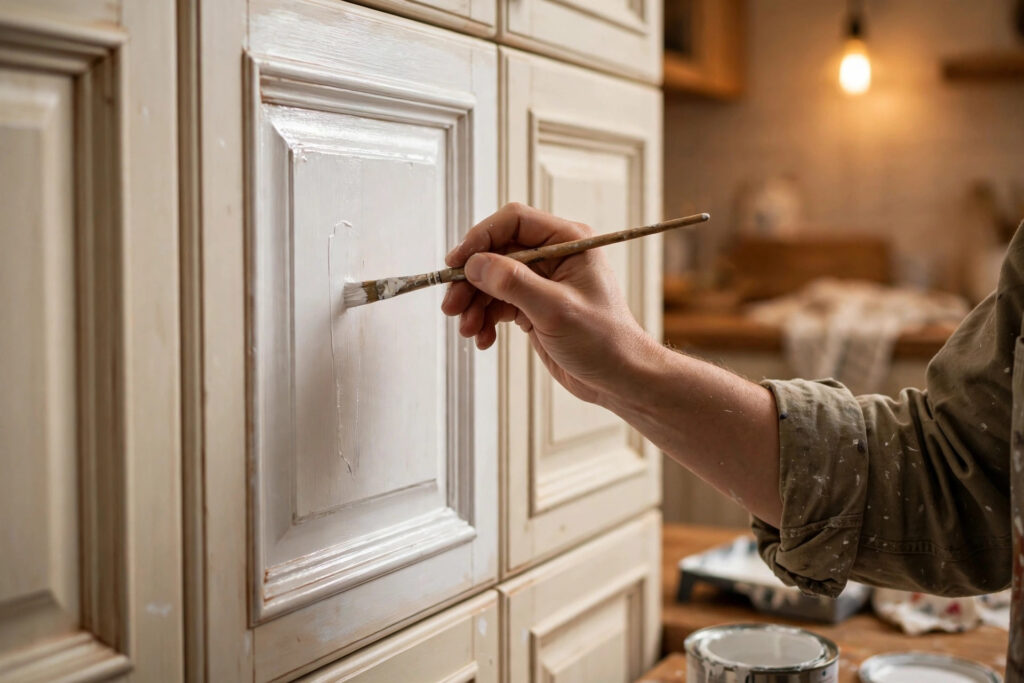
Hand application means exactly what it sounds like: a painter works the coating onto every surface with high-quality brushes and small foam or mohair rollers. Doors usually still come off — any painter worth hiring removes them — but the coating goes on by hand rather than through a sprayer.
Brushing has one real advantage: control. A skilled painter can work coating into detailed profiles, grooves, and inside corners that a sprayer might flood or miss. On heavily detailed raised-panel doors, some painters argue a brush gets a more even build in the crevices.
The trade-off is texture. Even the best brush leaves micro-stipple; rollers leave a fine orange-peel texture. From across the kitchen you won’t notice. From two feet away, in raking light, you will. If your goal is that flat, glassy, factory look, brushing can’t quite get there.
Finish Quality: Head-to-Head
| Sprayed | Brushed / Rolled | |
|---|---|---|
| Smoothness | Glass-smooth, factory look | Fine stipple or light brush texture visible up close |
| Detail work | Excellent on flat and Shaker profiles; needs care on deep grooves | Better control in deep profiles and crevices |
| Coat consistency | Very even film thickness | Varies slightly with technique |
| Dust risk | Higher — airborne dust lands in wet finish; needs containment | Lower — less airborne material |
| Touch-ups later | Harder to blend invisible repairs | Easier to touch up seamlessly |
Does the Method Change How Long the Paint Lasts?
This is the question buyers ask most, and the research is clear: durability comes from prep and product, not from the applicator. A sprayed door and a brushed door coated with the same catalyzed urethane over the same degreased, sanded, primed surface will last essentially the same amount of time — typically 8 to 12 years in a working kitchen before you’ll want a refresh. (More on lifespan in our guide to how long cabinet painting lasts.)
Where method does affect durability is at the margins. Spraying lays down a more uniform film, and uniform film cures uniformly — thin spots from brushing are the first places to wear through on high-touch edges. Conversely, a sprayer in inexperienced hands can apply the coating too thick, which leads to cracking as it cures. Technique matters either way.
The real durability checklist, regardless of method:
- Degreasing: kitchen cabinets collect years of cooking grease. If it’s not stripped, nothing sticks properly.
- Sanding: scuff-sanding gives the primer something to grip.
- Bonding primer: a dedicated adhesion primer, not paint-and-primer-in-one.
- Coating system: a cabinet-grade urethane or catalyzed finish, applied at the manufacturer’s specified thickness.
- Cure time: the finish may feel dry in hours but needs days to reach full hardness. Ask your painter when you can actually use the kitchen normally.
If a painter can’t walk you through all five, the sprayer-versus-brush debate is beside the point — keep looking.
What Does Each Method Cost in Cincinnati?
Professional cabinet painting in the Cincinnati area typically runs $1,800 to $5,500 for a standard kitchen (roughly $90–$200 per door), depending on kitchen size, door style, and coating system. Nationally, basic brush-and-roll jobs can start around $1,000–$3,500, while premium sprayed finishes land in the $3,000–$5,000 range — still $15,000 to $20,000 less than full replacement at $18,000–$25,000.
Spraying usually costs more than brushing for the same kitchen, and the reasons are legitimate: containment setup, masking, equipment, and the higher-grade coatings that spraying demands. You’re paying for the booth-like conditions and the factory finish, not just the labor.
Be wary of quotes far below the local range in either direction. A suspiciously cheap spray quote often means no containment, no proper primer, or wall paint through a sprayer — which will look great for six months and then start chipping.
Timeline: How Long Will Your Kitchen Be Disrupted?
Most professional cabinet painting takes a few days to a week. Dedicated cabinet companies advertise faster turnarounds — some spray operations complete in 1 to 3 days — while thorough full-service processes run about 5 to 7 business days including cure time.
Spraying is usually faster on the application itself but slower on setup: masking and containment take real time. Brushing skips most of the masking but each coat goes on slower. Net difference for a typical Cincinnati kitchen is usually a day or two, not a week.
Dust, Fumes, and Living in Your House During the Job
Spraying puts fine finish material in the air — that’s physics. A professional crew manages it with plastic containment around the kitchen, floor and countertop protection, and ventilation or fume extraction. Some companies specifically advertise fume exhausters as part of their process. Ask about it directly: “How do you keep overspray and fumes out of the rest of my house?”
Brushing generates almost no airborne material, which makes it the lower-disruption option if someone in the home is sensitive to fumes or dust. Either way, plan to keep the kitchen off-limits during coating days and give the finish its full cure time before heavy use.
So Which Should You Choose?
Choose spraying if: you want the smoothest possible factory look, your doors are flat-panel or Shaker style, and you’re hiring a crew with real spray experience and proper containment.
Choose brushing if: your cabinets have deep, detailed profiles; someone in the home is highly sensitive to airborne finishes; or the price difference is significant and the painter’s brushed work (ask for photos) looks great.
Walk away if: the painter can’t explain their prep process step by step, can’t name the exact coating system they’ll use, offers no written warranty, or can’t show you before-and-after photos of similar kitchens. Those answers matter far more than the tool in their hand.
Questions to Ask Before You Hire
Buyers comparing painters consistently ask the same smart questions. Use them:
- Do you spray or brush — and why do you prefer that method for my cabinets?
- Walk me through your prep process, start to finish.
- What exact coating system will you use — primer and topcoat, brand and product names?
- How do you control dust and overspray in my home?
- What’s the realistic timeline, including cure time before I can use the kitchen normally?
- What does your written warranty cover? (See our cabinet painting warranty guide for what to look for.)
- Can I see before-and-after photos of kitchens like mine?
At CincyEdge, our professional cabinet painting in Cincinnati uses a full spray process with cabinet-grade urethane coatings, documented prep, and a written 1-year warranty — and we’ll happily answer every question above before you sign anything. Call (877) 708-9363 for a free estimate.
Spray vs Brush Cabinet Painting: FAQs
Do professional painters spray or brush kitchen cabinets?
Most dedicated cabinet painting companies spray — it produces the smooth, factory-like finish buyers expect. General painters more often brush and roll. Neither is automatically better; ask about prep, coating system, and warranty rather than judging by the tool alone.
Does spraying cabinets last longer than brushing?
Not inherently. Durability comes from surface prep and the coating system (degreasing, sanding, bonding primer, cabinet-grade urethane or catalyzed finish). A well-prepped brushed finish outlasts a poorly prepped sprayed one every time.
Does spray cabinet painting cost more?
Usually, yes — spraying requires containment setup, masking, equipment, and premium coatings. In Cincinnati, expect professional cabinet painting to run $1,800–$5,500 total, with sprayed finishes toward the higher end of that range.
Can you get a smooth finish brushing cabinets by hand?
Close, but not identical. A skilled painter with quality brushes and foam rollers can achieve a very smooth hand-applied finish, but fine stipple or brush texture will be visible up close in raking light. Only spraying gives a truly flat, glass-like surface.
Is spraying cabinets messy? Will it get paint all over my house?
It can be, which is why containment matters. A professional crew seals the kitchen with plastic sheeting, protects floors and countertops, and uses ventilation or fume extraction. Ask specifically how they control overspray before hiring.
Do painters spray the insides of cabinets and drawers?
Typically no — interiors are usually left as-is unless you have glass-front doors or specifically request it. Confirm what’s included in your quote so there are no surprises.