
Do Outdoor Kitchens Add Home Value? What The Data Says
What Do Buyers Actually Pay For?
Do buyers pay more for an outdoor kitchen? Here’s what the data says about ROI in the Cincinnati market.
You are thinking about spending $15,000–$25,000 on a backyard kitchen, and the responsible question is: will I get any of that back when I sell? It is the right question to ask before you commit — and unlike most remodeling ROI questions, this one has a genuinely encouraging answer.
Short version: yes, outdoor kitchens add home value — they are consistently ranked among the best-recouping backyard improvements. Longer version below: the actual numbers, what specifically buyers pay extra for, when an outdoor kitchen does not pay off, and how Cincinnati’s market factors in.
The Numbers: What Outdoor Kitchens Return
Industry analyses put the return on a well-built outdoor kitchen at roughly 55–75% of project cost at resale, with several studies clustering around 70%. One widely cited figure: a $14,000 outdoor kitchen project recoups about 71% — roughly $10,000 back in added home value.
That puts outdoor kitchens ahead of most interior discretionary projects and squarely in the territory of the best backyard investments, alongside decks and professional landscaping. For context, the RTA 2026 study found median outdoor kitchen orders between $14,014 and $25,793 — right in the zone where the ROI math works best.
Important framing: “71% recouped” does not mean you profit. It means a $20,000 kitchen adds roughly $14,000 to your sale price — and you got years of backyard cooking in the bargain. Remodeling ROI is about recovering cost while enjoying the improvement, and outdoor kitchens do that better than most projects.
Why Buyers Pay Extra for Outdoor Kitchens
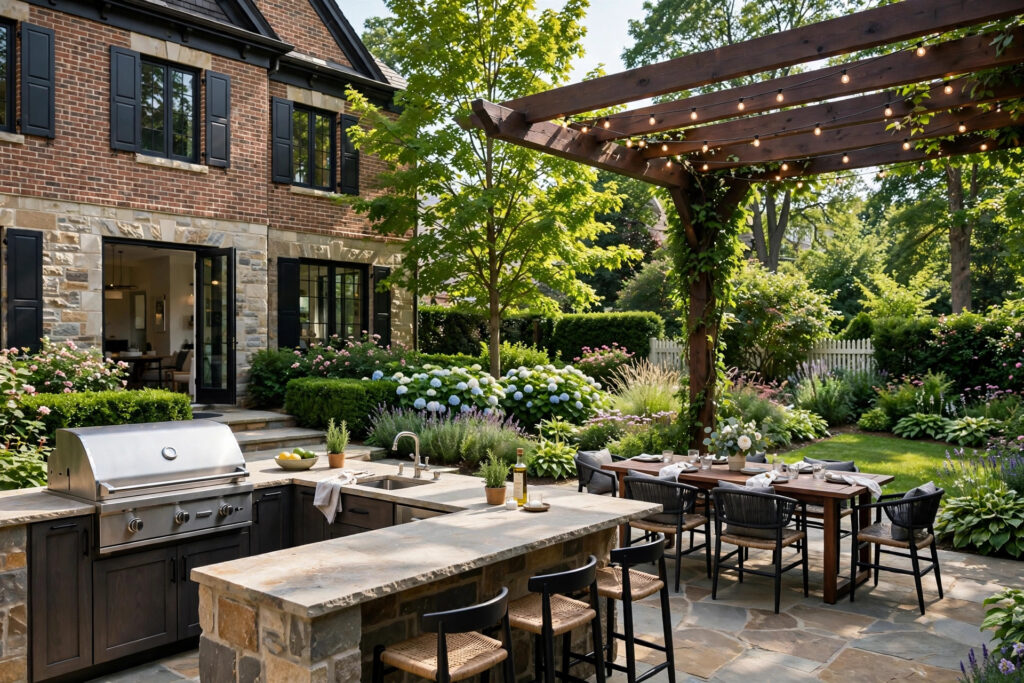
Walk through the buyer’s eyes at an open house in Mason or Blue Ash. Two comparable homes, similar price — one has a built-in outdoor kitchen with a stone island, lighting, and bar seating; the other has a patch of lawn and a rusting portable grill. Which one gets the emotional bid?
- Perceived living space: a finished outdoor kitchen reads as an extra “room,” expanding the home’s functional square footage in the buyer’s mind.
- Entertainment value: post-2020, buyers explicitly shop for homes that entertain — outdoor kitchens signal a lifestyle, not just a feature.
- Move-in readiness: buyers pay premiums to avoid projects. A done, permitted, quality outdoor kitchen is one fewer thing on their list.
- Neighborhood signaling: in suburbs where outdoor living is common, lacking one can make a home feel behind the curve.
Built-In vs Portable: Only One Adds Value
This distinction decides the entire ROI question. Built-in outdoor kitchens add value; portable grills do not. Appraisers and buyers treat them completely differently:
- Built-in: permanent structure, utility connections, quality materials — appraised as a real improvement. With proper materials (304 stainless, sealed stone, frost-rated tile), it lasts 15–25 years.
- Portable: personal property, not real property. A $2,000 grill on the patio adds exactly $0 to appraised value, and you will replace it several times over the lifespan of one built-in.
If resale value matters to you, build it in. The permanence is literally what you are paying for.
What Cincinnati Buyers Specifically Value
Local market nuances matter. In Greater Cincinnati:
- Four-season thinking: buyers here know winter exists. Covered or pergola-shaded kitchens with heaters read as usable 8+ months; fully exposed ones read as 5-month novelties. Shade structures ($10–$60/sq ft for pergolas) measurably widen the appeal.
- Mid-range sweet spot: the $12,000–$20,000 kitchen recoups best proportionally. Modest, well-built beats extravagant — a $40,000 outdoor kitchen in a $250,000 neighborhood will not return proportionally.
- Quality over gadget count: one excellent grill and solid stonework impress buyers more than five cheap appliances. Buyers notice build quality; they discount gimmicks.
- Permitted work: unpermitted gas and electrical work is a liability at sale, not an asset. Permitted, inspected work is part of what makes it “real” value.
When an Outdoor Kitchen Does NOT Pay Off
Honesty requires the other side:
- Overbuilding for the neighborhood: the costliest mistake. Keep the project proportional — roughly in line with what comparable homes offer.
- Cutting corners on materials: a rotting wood structure or rusting appliances subtract value by signaling deferred maintenance.
- Weird placement: a kitchen stranded far from the house, with no lighting or path, reads as a burden rather than a feature.
- DIY gas/electrical: unpermitted utility work can kill a sale during inspection. This is non-negotiable.
The Smart Play: Value + Enjoyment
The homeowners who “win” with outdoor kitchens think in two columns: resale math and use value. A $16,000 kitchen that returns ~$11,000 at sale and hosts fifty summer cookouts in between is not a 71% return — it is a 71% return plus five years of the best room in the house.
Wondering what it would cost to build yours? See our 2026 outdoor kitchen cost guide for Cincinnati for real price brackets and money-saving strategies.
Ready to talk through a design? CincyEdge are experienced outdoor kitchen builders serving Greater Cincinnati — permitted, winter-ready, and built to add real value. Free estimates: (877) 708-9363.
The “Use Value” Multiplier Most ROI Articles Miss
Published ROI figures only measure the resale transaction. They miss the fifty summer cookouts, the kids’ birthday parties, the quiet Tuesday dinners outside in September — the actual reason anyone builds one of these. Economists would call it consumer surplus; your family will just call it the best room in the house.
Think of it this way: a $16,000 kitchen that returns $11,000 at sale cost you $5,000 net for five-plus years of outdoor living. That is under $100 a month for a permanent upgrade to how your home feels every single summer. Few remodeling projects offer that combination of financial recovery and daily enjoyment — which is exactly why outdoor kitchens keep showing up at the top of “worth it” lists.
The caveat, as always: the math only works if you actually use it. If your household eats out six nights a week and nobody grills, even a 71% recoup is a bad investment. Be honest about your lifestyle before you commit — the happiest outdoor-kitchen owners are the ones who were already living half their summer in the backyard.
Outdoor Kitchen Value FAQs
Do outdoor kitchens increase home value?
Yes. Well-built outdoor kitchens are among the best-recouping backyard improvements, typically returning 55–75% of project cost at resale — around 71% in widely cited analyses. Built-in kitchens count; portable grills do not.
How much value does an outdoor kitchen add?
On a $14,000 project, roughly $10,000 in added home value (about 71%). Returns scale with quality and neighborhood fit — mid-range projects in the $12,000–$20,000 zone recoup best proportionally.
Is an outdoor kitchen worth the money?
If you will use it, absolutely: you recover most of the cost at resale and get years of outdoor living. The math works worst for overbuilt projects in modest neighborhoods and best for quality mid-range builds.
Do appraisers count outdoor kitchens?
Built-in, permitted outdoor kitchens with utility connections are counted as real property improvements. Portable setups are personal property and add nothing to appraised value.
What outdoor features add the most resale value?
Decks, professional landscaping, and built-in outdoor kitchens top most lists. Within outdoor kitchens specifically, buyers respond most to quality grills, solid stonework, lighting, and shade structures.
Should I add an outdoor kitchen before selling my Cincinnati home?
Only if the neighborhood supports it and you build mid-range with quality materials. A rushed cheap build can hurt more than help. If you are selling within a year, talk to a local agent about what comparable homes offer first.