
Is Cabinet Refacing Worth It?
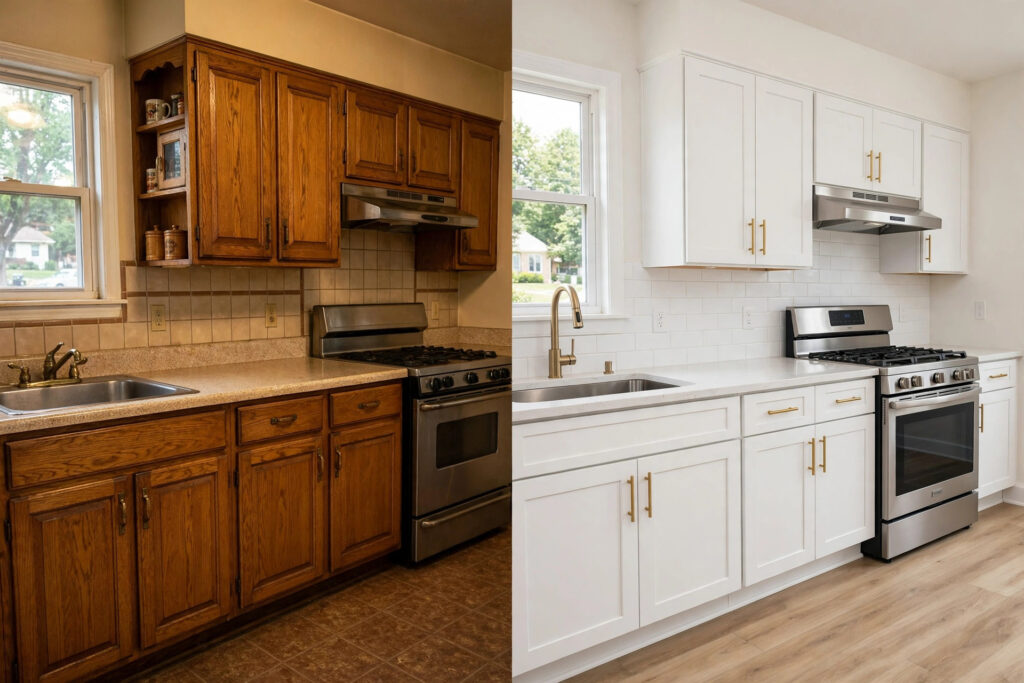
Save 30–50% — When It’s the Right Call
Refacing costs far less than replacement, but it’s not right for every kitchen. Here’s how to tell if it’s worth it for yours.
Your kitchen looks tired, but the cabinets themselves are solid and the layout works. A full remodel would cost $20,000 to $60,000+. Cabinet refacing promises a like-new kitchen for a fraction of that — but is it actually worth the money, or is it a compromise you’ll regret?
Here’s the data-driven answer: for the right kitchen, refacing is one of the highest-value upgrades in remodeling. For the wrong kitchen, it’s money spent twice. This guide gives you the numbers and the decision framework so you know which category you’re in.
What Refacing Costs vs. What Replacement Costs
Let’s start with the numbers, because they’re the whole argument:
| Option | Typical Cincinnati cost | Timeline | Lifespan |
|---|---|---|---|
| Cabinet refacing | $4,000–$9,500 | 3–5 days | 15–20 years |
| Cabinet painting | $1,800–$5,500 | 3–7 days | 8–12 years |
| Full cabinet replacement | $20,000–$60,000+ | 1–3 weeks | 25–50 years |
| Full kitchen remodel | $15,000–$50,000+ | 4–12 weeks | 25+ years |
Refacing typically costs 30–50% of replacement. For a kitchen where replacement would run $25,000, refacing at $6,000–$8,000 saves you roughly $17,000–$19,000 — and finishes in days instead of weeks, with your kitchen usable throughout. (See how long refacing takes for the day-by-day timeline.)
Wood veneer refacing — the premium option with real wood faces — runs toward the higher end, with veneer materials alone in the $2,000–$6,000 range depending on wood species and kitchen size. Laminate and rigid thermofoil options cost less while still delivering a fresh, modern look.
The ROI Case: 70–80% Return
Cabinet refacing is routinely cited at a 70–80% return on investment at resale — among the best of any kitchen upgrade. The logic is simple: buyers see a kitchen that looks new, and appraisers credit updated kitchens, but you didn’t pay new-kitchen prices to get there.
A $7,000 refacing job that returns 75% adds about $5,250 in perceived home value — and you got to enjoy a beautiful kitchen for years before selling. Compare that to a $40,000 full remodel returning 60%: $24,000 back, but $16,000 more out of pocket and weeks of disruption.
Is refacing a “safe housing investment”? For most Cincinnati neighborhoods and price points, yes — it’s one of the safest cosmetic investments you can make, precisely because the cost stays low relative to the visual transformation.
What You Actually Get: The 15–20 Year Lifespan
A quality refacing job lasts 15 to 20 years. That’s not marketing — it’s the nature of the materials. New hardwood doors and drawer fronts with a factory finish, plus fresh veneer bonded to your existing boxes, are genuinely new surfaces. They wear like new cabinets because, on every surface you see and touch, they are new cabinets.
The cabinet boxes underneath were built to last decades — that’s why refacing works. Kitchen cabinet boxes from the 1980s, 90s, and 2000s are typically solid wood or quality plywood construction. The doors were the dated part, not the structure.
When Refacing Is Absolutely Worth It
Refacing is the right call when all (or most) of these are true:
- Your cabinet boxes are structurally sound. No water damage, no warping, no broken frames. Solid boxes are the foundation refacing needs.
- You like your kitchen layout. Refacing doesn’t move walls, plumbing, or appliances. If the workflow works, don’t pay to change it.
- Your budget is under $10,000. Refacing delivers the maximum visual transformation per dollar in this range — nothing else comes close.
- You want minimal disruption. 3–5 days, kitchen usable daily, no demolition. For busy households, this alone can decide it.
- You’re selling in the next few years. The 70–80% ROI and fast turnaround make refacing ideal pre-sale prep.
When It’s NOT Worth It
And here’s the honest counter — refacing is the wrong spend when:
- Boxes are damaged. Water damage, warping, or broken frames can’t be veneered over. (Full detail: when not to reface cabinets.)
- The layout wastes space or drives you crazy. No finish fixes a bad floor plan. If you need walls moved or the work triangle rebuilt, save for a remodel.
- You’re in a luxury market where buyers expect custom. In high-end Cincinnati neighborhoods, buyers at $700K+ often expect true custom cabinetry — refaced stock boxes may not meet expectations.
- You want to add significant storage. Refacing can add organizers and hardware, but it can’t create cabinet boxes where none exist.
A trustworthy contractor will walk through this checklist with you during the estimate and tell you honestly if you’re in the “don’t reface” category. If someone recommends refacing without inspecting your boxes, get a second opinion.
Refacing vs. Painting vs. Replacing: The Decision Matrix
| Your situation | Best option |
|---|---|
| Boxes sound, like the style, just want a color change | Painting ($1,800–$5,500) |
| Boxes sound, want a new door style and finish | Refacing ($4,000–$9,500) |
| Boxes damaged, or layout needs to change | Replacement / remodel ($20,000+) |
| Selling soon, need maximum impact per dollar | Refacing (70–80% ROI) |
| Dream kitchen, staying 15+ years, budget flexible | Full remodel |
The Benefits Beyond Money
Cost dominates the conversation, but homeowners consistently cite three non-financial reasons they’re glad they refaced:
Speed. From signed contract to finished kitchen in a couple of weeks (including material lead time), with only 3–5 days of actual work. A remodel eats a season of your life; refacing eats a long weekend plus a few days.
Sustainability. Your existing boxes stay out of a landfill. Refacing reuses the largest, most resource-intensive part of your cabinetry — a genuine environmental win that also happens to save you thousands.
Customization without construction. New door styles, new finishes, soft-close hinges, pull-out organizers, new hardware, crown molding, under-cabinet lighting — refacing projects routinely include the upgrades that make a kitchen feel custom, without moving a single wall.
The Bottom Line
Is cabinet refacing worth it? Yes — when your boxes are sound and your layout works. At $4,000–$9,500, a 3–5 day project, 15–20 year lifespan, and 70–80% ROI, it’s the highest-value path to a like-new kitchen for most Cincinnati homeowners. It’s not worth it when boxes are damaged or the layout is the real problem — and any honest contractor will tell you which situation you’re in.
CincyEdge offers professional cabinet refacing in Cincinnati with free in-home estimates, written timelines, and honest assessments — if your kitchen isn’t a good refacing candidate, we’ll tell you. Call (877) 708-9363.
Is Cabinet Refacing Worth It: FAQs
Is cabinet refacing worth the money?
For most homeowners, yes. At $4,000–$9,500 versus $20,000–$60,000+ for replacement, with a 15–20 year lifespan and 70–80% ROI at resale, refacing delivers the best value-per-dollar of any major cabinet option — provided your boxes are sound and your layout works.
Should I reface or replace cabinets when selling my home?
Reface if the boxes are sound, your budget is under $10,000, and the layout works — buyers see a new-looking kitchen and you keep costs low. Replace if boxes are damaged or sagging, the layout wastes space, or you’re in a luxury market where buyers expect true custom cabinetry.
How long do refaced cabinets last?
15 to 20 years. The new doors, drawer fronts, and veneer are genuinely new surfaces with factory-grade finishes — they wear like new cabinets because every visible surface is new.
Is cabinet refacing a good investment?
It’s considered one of the safest cosmetic home investments, with 70–80% of the cost typically recouped at resale. The low upfront cost relative to the visual transformation is what drives the strong return.
What are the benefits of cabinet refacing?
Cost savings of 50–70% versus replacement, 3–5 day installation with a usable kitchen throughout, 15–20 year lifespan, new door styles and finishes, upgraded hardware and organizers, and keeping quality cabinet boxes out of landfills.
Does refacing add value to my home?
Yes — an updated kitchen is one of the strongest value drivers in a home, and refacing delivers that updated look at a fraction of replacement cost. Most homeowners recoup 70–80% of the project cost in home value.