
How To Clean Quartz Vs Granite Countertops (Without Ruining Them)
One Wrong Cleaner Can Ruin Stone
The wrong cleaner can etch or dull your counters in a single wipe. Here’s the safe daily routine for each stone — and what to never use.
You just invested thousands in beautiful stone counters — the last thing you want is to etch, stain, or dull them with the wrong cleaner. The good news: both quartz and granite are easy to care for once you know the few rules that matter. The bad news: a handful of common household cleaners will quietly damage them, and most people learn that the expensive way.
This guide covers the daily routine for each stone, how to handle stains, exactly when to reseal granite (and why quartz never needs it), and the products to keep far away from your counters. Written for Cincinnati kitchens — including our hard-water reality.
Daily Cleaning: Quartz
Quartz is the lowest-maintenance countertop you can buy. The entire routine:
- Wipe with a soft cloth or sponge, warm water, and a drop of mild dish soap.
- Rinse the soap off with a damp cloth so no film builds up.
- Buff dry with a microfiber cloth if you want a streak-free shine.
That is it. Because quartz is non-porous, spills cannot soak in — even red wine or coffee discovered the next morning wipes away. For dried-on food, lay a warm damp cloth over the spot for a few minutes to soften it, then wipe; never scrape with a metal spatula or razor.
Daily Cleaning: Granite
Granite’s daily routine is nearly identical, with one extra rule about acids:
- Same as quartz: soft cloth, warm water, mild dish soap.
- Avoid vinegar, lemon-based cleaners, and anything acidic for everyday use — acids gradually wear down granite’s sealer.
- Dry with a microfiber cloth to prevent water spots, which show more on dark granite.
If you prefer a dedicated stone cleaner, any pH-neutral granite cleaner from the hardware store works fine. What you do not need: bleach-based sprays, ammonia, or abrasive powders like Comet. They dull the polish over time.
Sealing: The Big Difference
Granite: reseal about once a year
Granite is porous natural stone, and its stain resistance comes from the sealer, not the stone itself. Plan on resealing roughly once a year — some dense, dark granites can go longer, while light-colored or heavily used counters may need it sooner.
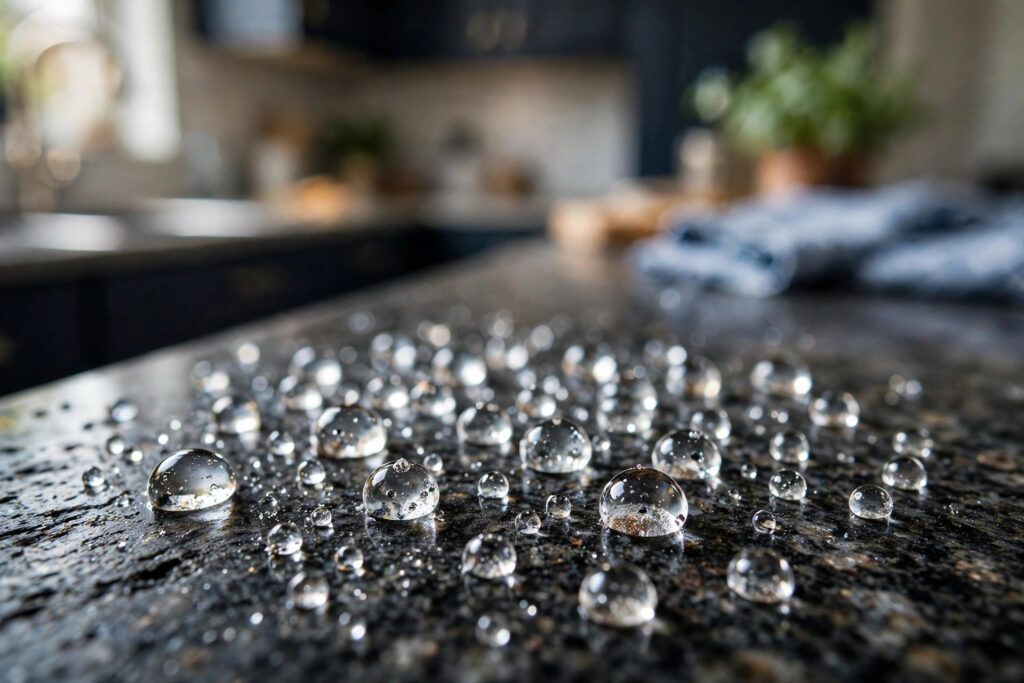
The water test: sprinkle a few drops of water on the counter. If it beads up, your seal is intact. If the stone darkens as it absorbs the water, it is time to reseal. Resealing is a simple DIY job: clean the counters, apply impregnating sealer evenly, let it penetrate per the label, buff off the excess. Most Cincinnati homeowners do it on a Saturday morning once a year.
Quartz: never seal, ever
Quartz’s resins make it permanently non-porous — there is nothing for a sealer to soak into, and applying one would just leave a hazy film. If anyone tries to sell you a quartz “sealing service,” politely decline.
Quartzite: do not confuse the two
Quartzite is a natural stone with a confusingly similar name. Unlike quartz, quartzite does need sealing every one to two years. If your counters are labeled quartzite, follow the granite schedule, not the quartz one.
Stain Removal: What to Do When Something Soaks In
On quartz, true stains are rare. For stubborn marks, make a paste of baking soda and water, apply it gently with a soft cloth, and rinse. For grease, a little degreasing dish soap does the job. Avoid harsh solvents.
On granite, organic stains (coffee, wine, food) usually respond to a poultice: baking soda mixed with water into a thick paste, spread over the stain, covered with plastic wrap, left 24 hours, then removed and rinsed. Oil-based stains use the same method with baking soda and a little acetone instead of water. Patience beats scrubbing — aggressive scouring damages the polish long before it removes the stain.
What NEVER to Use on Stone Countertops
- Bleach and bleach-based cleaners — dulls the polish on both stones over time.
- Oven cleaner, drain cleaner — far too caustic; can permanently discolor quartz resin.
- Abrasive powders and scouring pads — micro-scratches accumulate into a dull finish.
- Vinegar or lemon juice (granite) — acids etch through sealer with repeated use. Fine occasionally on quartz, but dish soap works just as well.
- Razor blades and metal scrapers — use a plastic putty knife for stuck-on gunk instead.
- Sustained high heat (quartz) — not a cleaner, but worth repeating: trivets always. Thermal shock can crack the resin.
Cincinnati-Specific Notes: Hard Water and Humidity
Much of Greater Cincinnati has moderately hard water, which means mineral spots on dark counters if you let water air-dry — especially on black or deep-gray granite and quartz. The fix is free: keep a microfiber cloth handy and give the counters a quick buff after wiping. If spots have already built up, a 50/50 mix of water and isopropyl alcohol cuts through mineral film safely on both stones.
Our humid summers are actually good news for granite sealer longevity (dry winter air is harder on it), but kitchens near exterior walls can see condensation in shoulder seasons — another reason to keep that annual resealing appointment.
Quick-Reference Care Card
| Quartz | Granite | |
|---|---|---|
| Daily cleaner | Dish soap + water | Dish soap + water (pH-neutral) |
| Sealing | Never | About once a year |
| Acids (vinegar, lemon) | OK occasionally | Avoid for daily use |
| Hot pans | Never directly — trivets | Fine |
| Stain risk | Very low | Low if sealed |
Still deciding between the stones? Read our quartz vs granite comparison for costs and trade-offs. And if your counters are due for replacement rather than just better cleaning, see our kitchen countertop installation service — CincyEdge templates digitally and installs across Greater Cincinnati. Free estimates: (877) 708-9363.
Seasonal Deep-Clean Checklist
Twice a year — say, spring and fall — give your counters a deeper reset beyond the daily wipe:
- Granite: do the water-bead test; reseal if the stone darkens. Clean grout-adjacent caulk lines where the counter meets the backsplash. Check for any chips at the edge that need a fabricator’s touch-up.
- Quartz: inspect seams and the sink cutout for any caulk gaps. Remove any built-up soap film with the baking-soda paste method. Confirm no one has been using the counter as a hot-plate landing zone — check with the household.
Ten minutes twice a year protects a multi-thousand-dollar surface. Put it on the same weekend you change your HVAC filter and you will never forget.
Countertop Cleaning FAQs
What is the best daily cleaner for quartz countertops?
Warm water, a drop of mild dish soap, and a soft cloth. Rinse and buff dry with microfiber. That is the entire routine — quartz needs nothing fancier.
How often should granite countertops be sealed?
About once a year for most kitchens. Do the water test: sprinkle water on the surface — if it beads, the seal is fine; if the stone darkens, reseal. Dense dark granites may stretch longer; light or heavily used counters may need it sooner.
Can I use vinegar on granite countertops?
Not for daily cleaning. Vinegar’s acidity gradually wears down granite’s sealer. Use pH-neutral dish soap or a dedicated granite cleaner instead.
How do you get stains out of granite?
Use a poultice: baking soda and water (for organic stains) or baking soda and a little acetone (for oil stains) into a thick paste, cover with plastic wrap for 24 hours, then remove and rinse. Avoid aggressive scrubbing, which damages the polish.
Does quartzite need sealing like granite?
Yes. Quartzite is a natural stone — despite the similar name, it is not the same as engineered quartz. Seal quartzite every one to two years, on the same schedule as granite.
Why are there white spots on my dark countertops?
Usually hard-water mineral deposits, common in Cincinnati. Wipe with a 50/50 mix of water and isopropyl alcohol, then buff dry with microfiber. Drying counters after wiping prevents them from returning.