
Quartz Vs Granite Countertops: An Honest Comparison For Cincinnati Kitchens
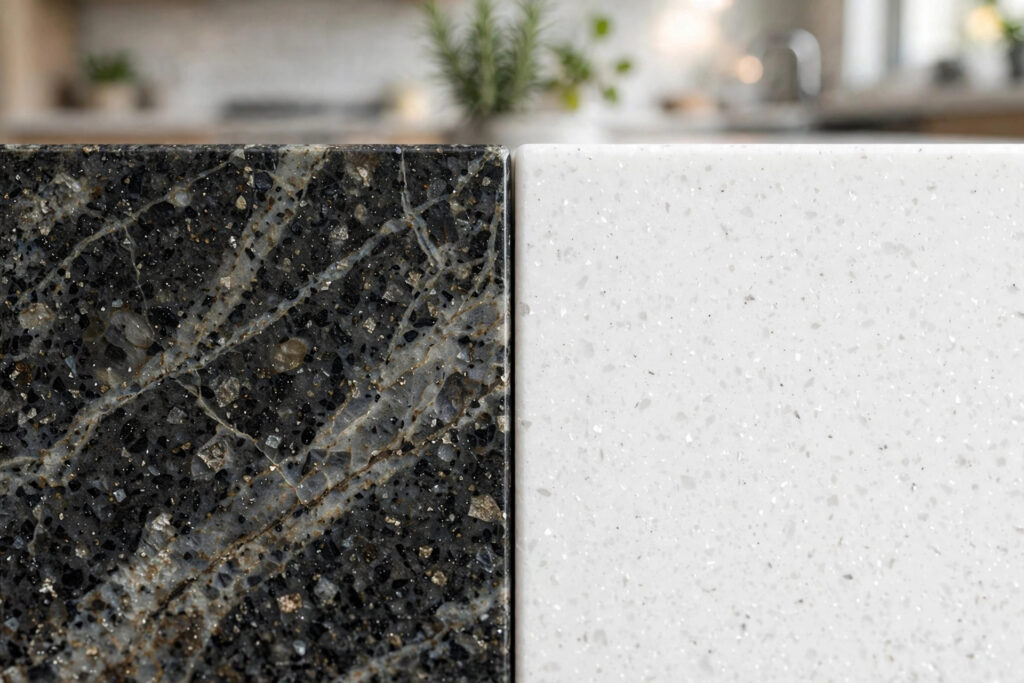
Two Stones, Very Different Kitchens
One needs sealing, the other doesn’t — and the price gap is real. Here’s the honest quartz vs granite breakdown for Cincinnati homes.
If you are remodeling your kitchen in Cincinnati, the quartz vs granite debate is probably the first big decision you will face after choosing your cabinets. Both materials look fantastic, both last for decades, and both show up in the nicest kitchens from Hyde Park to Mason. But they are very different stones once you live with them day to day.
This guide compares quartz and granite on the things that actually matter: what you will pay per square foot in the Cincinnati market, how each handles heat and stains, what maintenance each one demands, and which one makes more sense for the way your household really cooks. No sales pitch — just the trade-offs, so you can decide with confidence.
The Short Answer
In a hurry? Here is the one-paragraph version:
- Choose granite if you cook a lot with high heat, love the look of one-of-a-kind natural stone, and do not mind resealing your counters about once a year.
- Choose quartz if you want a stain-proof, zero-sealing surface with a consistent pattern — and you are willing to always use trivets under hot pans.
Neither choice is wrong. Most Cincinnati homeowners we talk to end up deciding on maintenance tolerance more than anything else: granite asks a little of you every year, quartz asks nothing after installation day.
Quartz vs Granite: Cost Comparison
Let us talk real numbers, because this is where most showroom visits get vague.
| Material | Installed cost per sq ft | Typical Cincinnati project |
|---|---|---|
| Granite | $40–$60 | ~$3,250 average |
| Quartz | $70–$100 | ~$4,500 average |
Those per-square-foot figures come from national installer data (Angi), and they track well with what we see quoted across Greater Cincinnati. For a standard 50-square-foot kitchen, the gap between mid-range granite and mid-range quartz often lands around $200–$500 on the total project — smaller than most people expect, because fabrication and installation labor is a big fixed chunk either way.
Cost aggregators put the average Cincinnati-area countertop project at about $3,346, with most falling between $916 and $6,115 depending on size, material grade, and edge details. Exotic granite slabs and premium quartz brands can push past those ranges, while straightforward kitchens with simple edges come in under them.
One honest note: the cheapest quote is rarely the best value. Templating accuracy, seam placement, and sink cutout quality are where low-ball fabricators cut corners — and you will stare at those seams every single day. Ask every bidder how they template (digital laser vs. plywood strips) and where your seams will fall before you compare prices.
Durability: Heat Resistance vs Stain Resistance
This is the real heart of the quartz vs granite decision, and each material wins one category decisively.
Heat: granite wins
Granite is born in magma. It shrugs off a hot skillet straight from the burner without blinking. Quartz, on the other hand, is about 90–93% crushed stone bound together with polymer resins — and resins do not love sustained high heat. A scorching pan set directly on quartz can discolor or even crack the resin. If you are the kind of cook who moves cast iron from stovetop to counter without thinking, granite is the safer stone, or commit to keeping trivets within arm’s reach forever.
Stains: quartz wins
Quartz is non-porous, which means red wine, coffee, turmeric, and tomato sauce wipe right off — even if you discover the spill the next morning. Granite is porous natural stone. Sealed properly it resists most stains, but leave that spaghetti sauce ring overnight on a light-colored granite and you may be looking at it for a long time. Busy households with kids tend to appreciate quartz’s forgiveness here.
Scratches and chips
Both are hard enough for daily kitchen abuse. Granite is slightly harder on the Mohs scale, but quartz’s resin content gives it a touch of flexibility that resists chipping at edges. In practice, neither will scratch under normal knife work — though you should still use a cutting board, because your knives will lose that fight against either stone.
Maintenance and Sealing: What Each One Asks of You
Here is where the two materials diverge most in daily life:
- Granite: needs resealing roughly once a year (some dense, dark granites can stretch longer). The test is simple — sprinkle water on the surface; if it beads, your seal is fine; if it darkens the stone, it is time to reseal. Day to day, clean with mild dish soap and water.
- Quartz: never needs sealing. Ever. Clean with mild soap and water and you are done. That is the entire maintenance program.
A quick word on quartzite, since the names confuse everyone: quartzite is a natural stone (different from engineered quartz) and it does need sealing every one to two years. If a sample is labeled “quartzite,” treat its maintenance like granite, not quartz.
What to avoid on both: bleach, oven cleaner, and abrasive powders. On granite specifically, skip vinegar and other acids for daily cleaning — they wear down the sealer over time. We cover the full routine in our quartz vs granite cleaning guide.
Looks and Style: Natural Variation vs Consistency
Granite is a slab of geology — every piece is one of a kind, with veining, speckling, and movement you will never see duplicated. If you love natural character, nothing else scratches that itch. The trade-off: the exact slab in the showroom photo may look noticeably different from the slabs actually in stock, so always approve your specific slabs in person before fabrication.
Quartz is engineered for consistency. The sample you fall in love with is essentially what arrives at your house. Modern quartz lines now mimic marble veining remarkably well, which is why quartz dominates contemporary, transitional, and farmhouse kitchens across Cincinnati’s newer builds in places like West Chester and Mason.
Both materials work across every design style we install — modern, traditional, transitional, farmhouse — and both come in the shapes Cincinnati kitchens actually need: straight runs, L-shapes, U-shapes, islands, and breakfast bars with proper overhangs for seating.
Resale Value: What Cincinnati Buyers Expect
In homes priced around $300,000 and up — which covers most of the Cincinnati suburbs we serve, from Blue Ash to Anderson Township — buyers simply expect stone countertops. Either quartz or granite checks that box. Appraisers and agents do not meaningfully distinguish between the two at resale; condition and overall kitchen quality matter far more than which stone you picked.
The one exception is the luxury tier: in high-end listings, natural stones like granite and especially quartzite carry a prestige signal that engineered quartz does not fully match. If you are remodeling a $700,000+ home in Indian Hill with resale in the near term, that is worth weighing.
So, Quartz or Granite? A 60-Second Decision Guide
- You cook with serious heat and hate babying surfaces → granite.
- You have young kids, entertain often, or dread maintenance → quartz.
- You want each slab to be unique → granite (and go approve slabs in person).
- You want the sample to match the installed counters exactly → quartz.
- Budget is the top priority → granite usually comes in lower per square foot.
- You are selling a luxury home soon → granite or quartzite for the prestige factor.
Still torn? That is exactly what a good fabricator consultation is for — bring your cabinet door sample and flooring sample, look at full slabs (not 4-inch chips), and talk through how you actually use your kitchen. If you are planning a full kitchen countertop installation in Cincinnati, CincyEdge can walk you through samples, honest pricing, and templating — call (877) 708-9363 for a free estimate.
Quartz vs Granite FAQs
Which is better, quartz or granite?
Neither is universally better — it depends on your priorities. Granite wins on heat resistance and natural uniqueness; quartz wins on stain resistance and zero maintenance. For most busy Cincinnati households, quartz’s forgiveness day to day makes it the easier stone to live with.
How much do quartz countertops cost compared to granite?
Granite typically runs $40–$60 per square foot installed (average project ~$3,250), while quartz runs $70–$100 per square foot (average ~$4,500). On a typical kitchen the total-project difference is often just a few hundred dollars once fabrication labor is included.
Does quartz need to be sealed?
No — quartz never needs sealing because it is non-porous. Granite needs resealing about once a year. (Do not confuse quartz with quartzite: quartzite is natural stone and needs sealing every one to two years.)
Can you put hot pans on quartz countertops?
You should not. Quartz’s resin binders can discolor or crack under sustained high heat. Always use trivets or hot pads. Granite handles hot pans without any issue.
Which countertop has the best resale value?
Both quartz and granite satisfy buyer expectations in most Cincinnati price ranges. In luxury homes, natural stones like granite and quartzite carry a slight prestige edge at resale.
What countertop shapes can be fabricated for my kitchen?
Both quartz and granite can be fabricated into straight runs, L-shaped and U-shaped layouts, islands, and breakfast bars. Your fabricator will digitally template your exact kitchen so seams and sink cutouts land in the best spots.